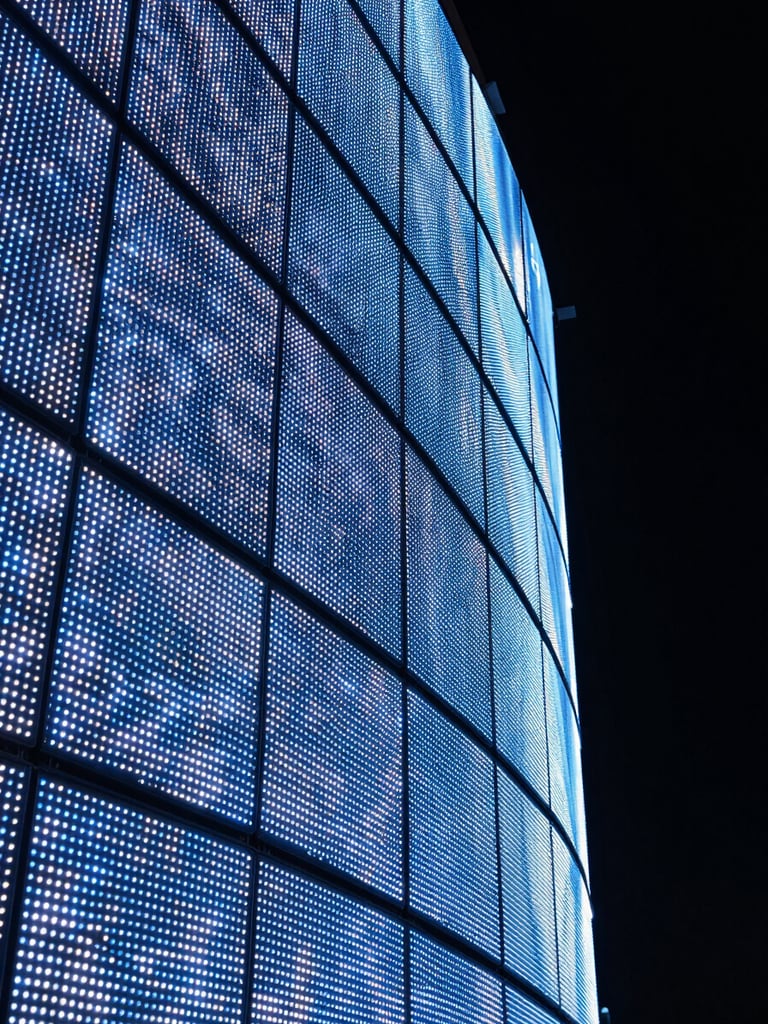
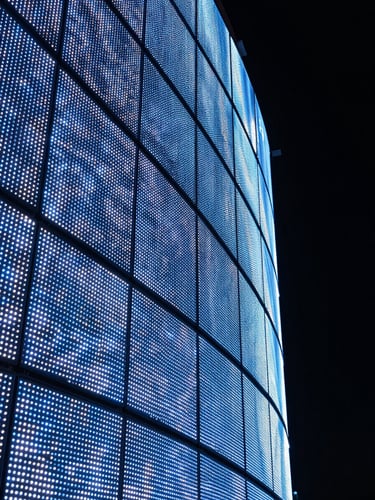
Geometry calibrated to the site's coordinate system.
Each panel format — anamorphic, curved, or rigid — carries a distinct structural and optical logic. No configuration is interchangeable; every deployment is solved from its vantage point outward.
Three formats. Three structural disciplines.
Flexible Panels
Curved Panels
Rigid Panels
Fixed-arc modules machined to a specified radius. Optical calibration accounts for off-axis luminance fall-off at each vantage point. Each arc is a specification item, not a field adjustment.
Substrate rated for continuous bend radii down to 500 mm. Pixel pitch held within ±0.1 mm across the full flex arc. Designed for cylindrical column wraps and curved stage fascia.
Die-cast aluminum cabinets with sub-millimeter flatness tolerance. Bezel geometry is a structural constraint, not a trim choice. Rated for outdoor IP65 exposure without optical compromise.
Seams, bezels, and radii are specification items.
Seam gaps are held to under 0.3 mm across abutting cabinets. Bezel width is defined in the site geometry model, not chosen on-site. Curve radii are machined, not bent.
Anamorphic calibration maps the display surface to 3D spatial coordinates derived from the primary vantage point. The content plane is solved mathematically before a single pixel is programmed.